
"The $2.3-billion budget deficit I inherited when I came into office became a $2.9-billion surplus."

Our only agenda is to publish the truth so you can be an informed participant in democracy.
We need your help.
Rudy Giuliani often boasts of turning a "$2.3-billion budget deficit into [a] $2.9-billion surplus by FY 2001" while he was mayor of New York City. He sometimes refers to the surplus as a "multibillion-dollar" one.
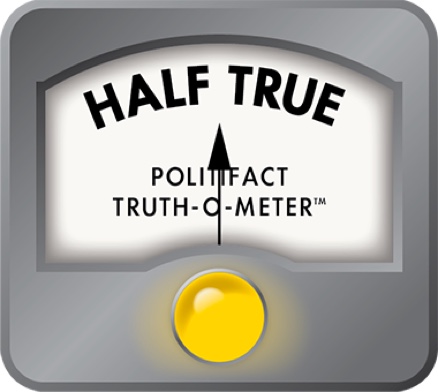
Although his figures are correct, he doesn't include his full eight years in office.
When Giuliani took office on Jan. 1, 1994, city spending was in the hole by $700-million, according to figures provided by a former Giuliani budget director, Bob Harding, at the request of the Giuliani campaign. The budget forecast for the next fiscal year, which would begin July 1, 1994, projected a gap between revenues and spending of $2.3-billion.
Jump ahead seven years, to June 30, 2001, the end of Giuliani's last full fiscal year in office. The city wound up with the $2.9-billion surplus Giuliani is boasting about. So far, so good.
But the last budget Giuliani wrote, for the 2001-02 fiscal year beginning the next day, had higher spending with a much smaller surplus – a $350-million surplus, to be precise, as of the day he left office. And Giuliani's budget forecast for the next fiscal year, 2003, says Harding, included a deficit of $3.1-billion that Giuliani's successor, Michael Bloomberg, would have to close. After the 9/11 attacks, that projection ballooned to $4.77-billion, according to figures from the New York City Office of Management and Budget. (The figures are not adjusted for inflation.)
What Giuliani has done is include the budget that outgoing Mayor Dinkins wrote as he left office, but doesn't include the budget Giuliani himself wrote as he left office. Including both is closer to a fair comparison of the two changes of administration. It looks at (1) the moment he took office and left, and (2) the out-year projection for the first full fiscal year of the new administration as of the same date.
So Giuliani inherited a deficit of about $700-million and left a surplus of $350-million as of the first and last days of his tenure. He also inherited a projected budget gap of $2.3-billion for his next fiscal year, and left his successor, Bloomberg, a projected deficit of $4.7-billion.
It is probably worth noting that both out-year "deficit" figures – the one Giuliani says he inherited from Dinkins and the one he bequeathed to Bloomberg – are just projections. The city (unlike the federal government) is not allowed to end the year with an operating deficit. Harding notes that gaps in out-year budgets have often happened in New York City and have, through a combination of above-budget revenues or below-budget spending, gotten into balance or turned to surplus by the time the year ends.
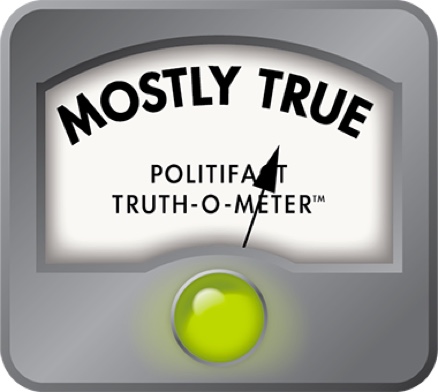
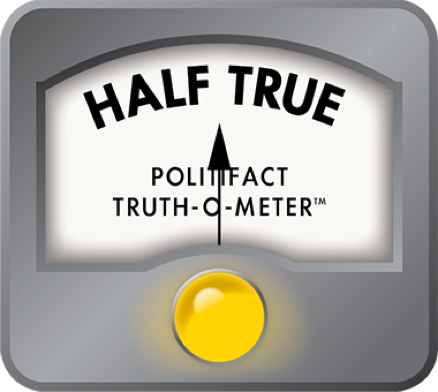
Add it all up and we only get halfway to true.
Citizens Budget Commission, "Rudolph W. Giuliani's Fiscal Record as Mayor of New York City," June 6, 2007
Citizens Budget Commission, New York's Competitiveness: A Scorecard for 13 Metropolitan Areas, July 2001
Citizens Budget Commission, New York City Budget Report Card, Fiscal Year 2002
Eugene J. Keilin, chairman, Citizens Budget Commission, Letter to Mayor Rudolph Giuliani, April 15, 1999
Citizens Budget Commission, Managing the Budget in the Bloomberg Administration, December 2001
Giuliani Campaign Web site, Rudy Got Results as Mayor of New York City
Giuliani Campaign Web site, Rudy Makes Cents Day Five: Under Mayor Giuliani, New York's Private Sector Regained Its Strength
New York Times, Clinton, in a Visit, Offers $120-Million for New Officers
New York City Independent Budget Office, Fiscal Outlook 2001 to 2004
New York City Independent Budget Office, Debt Affordability in New York City (Prepared Testimony, June 3, 1998)
Interviews: Bob Harding, former Giuliani budget director; Charles Brecher, executive vice president and research director, Citizens Budget Commission; Douglas A. Criscitello, former executive director of New York City Independent Budget Office; Ronnie Lowenstein, executive director of New York City Independent Budget Office.















In a world of wild talk and fake news, help us stand up for the facts.