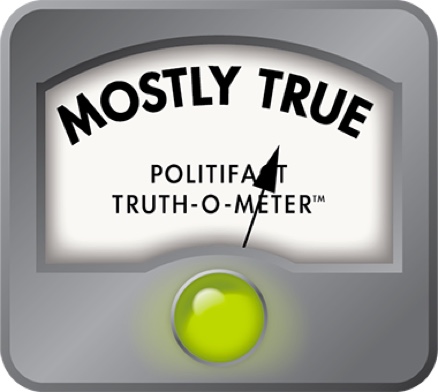
John McCain "is proposing tax cuts that would give the average Fortune 500 CEO an additional $700,000 in tax cuts."

Our only agenda is to publish the truth so you can be an informed participant in democracy.
We need your help.

In a debate in Nashville on Oct. 7, 2008, Barack Obama and John McCain tussled over tax policy.
Obama, responding to a question about fiscal responsibility, said the federal debt needs to be reduced in a way that shares the burden fairly.
"Now, when Senator McCain is proposing tax cuts that would give the average Fortune 500 CEO an additional $700,000 in tax cuts, that's not sharing a burden."
To come up with that number, the Obama campaign cites an average CEO salary of $12.8-million and a tax savings of 5.5 percent for the top earners during the year 2012 under a McCain administration. That comes to about $705,000.
The math is accurate, but the numbers require a small amount of explanation.
The $12.8-million comes from a Forbes magazine study of the average CEO compensation in 2007 for the 500 largest companies. Technically speaking, this would not be the Fortune 500, a listing compiled by Fortune magazine. An extremely minor point, but we note it to give Forbes its due for compiling the study.
The 5.5 percent tax savings comes from the nonpartisan Tax Policy Center, which estimated tax impact for income brackets under the McCain plan. They created an analysis that draws on the candidates' campaign stump speeches, and found that according to those proposals, the top 0.1 percent of taxpayers would get a 5.5 percent decrease in their tax rates in 2012 under McCain's plan. That comes to $700,000.
But the center also did an analysis based on information from the candidates' economic advisers, and those policies are slightly more conservative than what the candidates say in their stump speeches. For example, the candidates will talk about a proposal as if it will begin immediately, when the advisers say it will actually be phased in. Using the more conservative analysis, CEOs would receive a tax rate decrease of 2.1 percent, or about $270,000. That's still a big number, but not quite as big as $700,000.
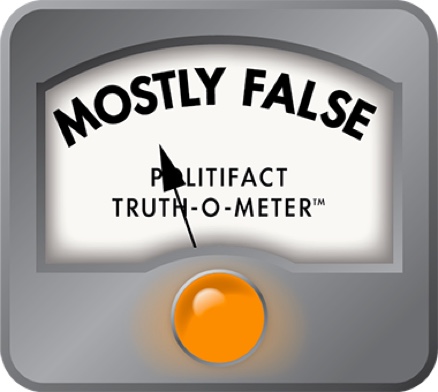
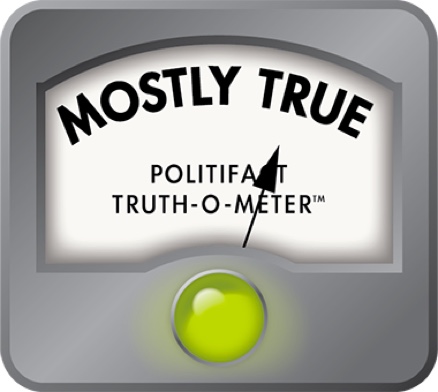
It's not surprising that candidates select the numbers most advantageous to their argument, but it's worth noting that there is a different way to look at this calculation that is also valid. Still, Obama is using credible numbers from independent sources to make his point. It does seem that high earners do better under John McCain's plan. We rate his statement Mostly True.
Forbes magazine, Top Paid CEOs , April 30, 2008
Tax Policy Center, Senator McCain's Tax Proposals as Described in his Stump Speeches, Tax Cuts Extended Baseline Distribution of Federal Tax Change by Cash Income Percentile, 2012.
Tax Policy Center, Senator McCain's Tax Proposals as Described by his Economic Advisors, Tax Cuts Extended Baseline Distribution of Federal Tax Change by Cash Income Percentile, 2012.
Presidential Debate Transcript , Oct. 7, 2008


















In a world of wild talk and fake news, help us stand up for the facts.