A story about the US and vaccines in 5 charts
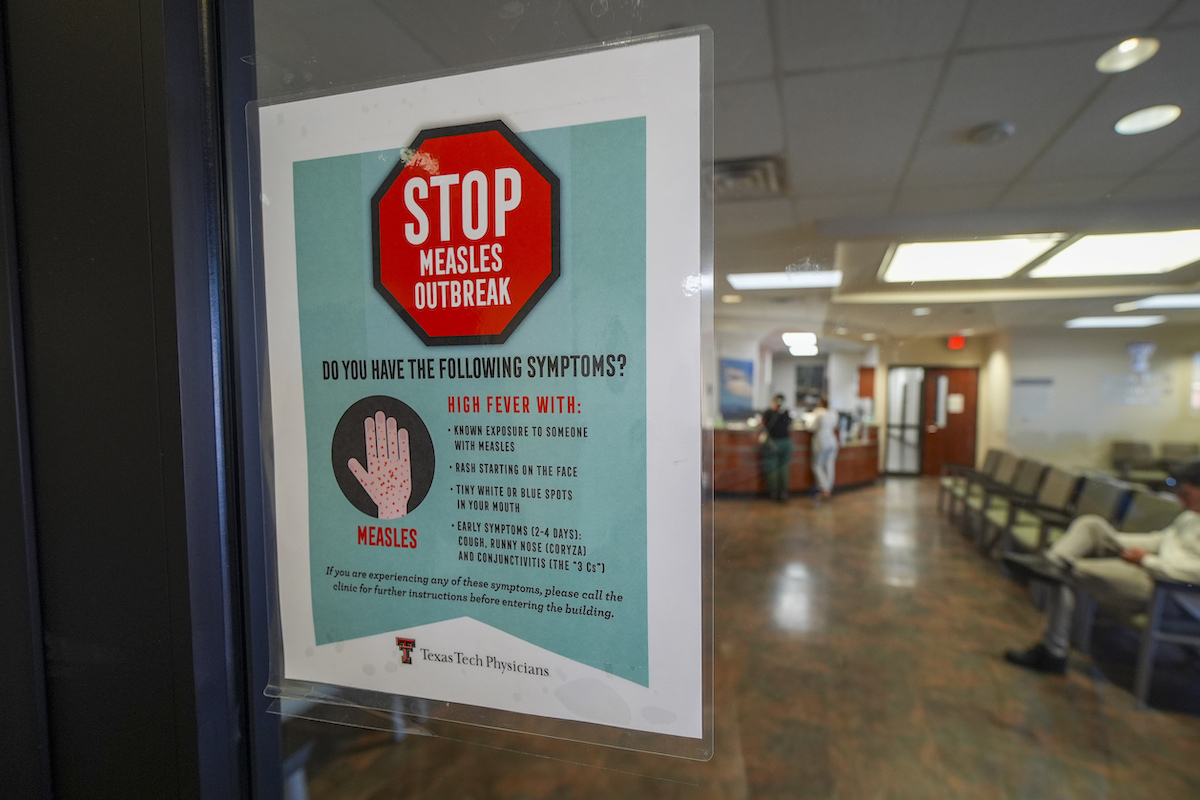

Coverage of rising U.S. measles cases is often coupled with news about Americans’ declining confidence in vaccines.
Scientists are quick to differentiate between correlation — when two things are related but not necessarily dependent on one another — and causation, when one thing causes another.
But when it comes to vaccine trust and vaccination rates, data shows in the U.S., parents are less likely to fully vaccinate their kids when their beliefs call into question whether vaccines are safe, effective or necessary.
“There’s a correlation there,” said Lunna Lopes, a senior survey manager at the health policy research group KFF. “That relationship remains significant even when we control for factors like age, education and partisanship.”
Falling vaccination rates have predictable consequences. Cases of measles — a disease declared “eliminated” in the U.S. in 2000 — have been rising in recent years. The U.S. has already reported nearly 500 more cases of measles in the first eight months of 2026 than in all of 2025, according to Centers for Disease Control and Prevention data.
The exact factors driving upticks in such vaccine-preventable illnesses aren’t easy to pin down, but here are five charts that tell some of the story.
United States vaccination trends
During the 2025-26 school year, there was a 0.1% overall drop in vaccination coverage among students entering kindergarten, the CDC reported.
The decline follows an overall trend of falling vaccination coverage among kindergartners that has been largely consistent regardless of the type of vaccine since the COVID-19 pandemic.
Even small percentage declines leave thousands of children unprotected, health experts say. For the 2025-26 school year, about 280,000 kindergartners attended school without documented completion of the measles, mumps and rubella vaccine series, or MMR, for example.
Robin Mejia, a biostatistics professor at the University of Washington’s School of Public Health, said the nation’s 0.1% overall vaccination decline doesn’t hit every place evenly.
“There’s going to be huge drops in some regions and in some school districts, and hardly any drops in others,” Mejia said. “That’s what allows things like measles to spread.”
CDC data showed that during the 2025-26 school year, a growing share of parents requested their children be permitted to attend school without being fully vaccinated.
Requests for exemptions from vaccine requirements for medical reasons have remained relatively consistent for years, but requests for non-medical exemptions have increased consistently since the 2020-21 school year.
During the same period, the overall percentage of children vaccinated against measles, mumps and rubella generally decreased.
Epidemiologists say 95% of people need to receive the MMR vaccine to achieve herd immunity, preventing community transmission. During the 2025-26 school year, just 10 states were at or above that threshold.
So far in 2026, there have been over 2,700 measles cases in the U.S. In 94% of those cases, the person was unvaccinated or their vaccination status was unknown, the CDC reported.
In 2025, two school-aged children and one adult died of measles. All were unvaccinated.
On Aug. 25, authorities announced “two measles-associated deaths” in unvaccinated people in Pennsylvania. One was a newborn who a coroner said died of an internal hemorrhage and traumatic spleen rupture; the coroner found evidence of the measles virus in the baby’s lung tissue, but it’s unclear exactly what role the measles infection played in the death.
Belief in falsehoods about vaccines is linked to decisions to delay, skip them
Since 2015, the Vaccine Confidence Project has found that support for statements such as “vaccines are safe” and “vaccines are compatible with my beliefs” has fluctuated.
As of 2023, belief in the statements “vaccines are important for children to have,” “vaccines are safe,” and “vaccines are effective” had fallen compared with 2015.
It’s difficult to say exactly what role vaccine myths and falsehoods ultimately play in vaccination decisions, but in May 2026, KFF found correlation between parents reporting belief in false statements about vaccines and their decisions to skip or delay some vaccines.
Parents who said they avoided or postponed getting their kids fully vaccinated were about twice as likely as other parents to say they believed certain vaccine falsehoods were “definitely” or “probably true.”
KFF’s Lopes said relatively small shares of people believe that these sorts of vaccine myths are definitely true.
“But what we do see is that a lot of people fall in what we call this kind of muddled middle,” she said. Those people might not outright reject or accept false statements about vaccines, and instead might report them as either “probably true” or “probably false.”
RELATED: How do countries without school vaccination requirements maintain high vaccination rates?
Our Sources
Interview with Lunna Lopes, a senior survey manager for the Public Opinion and Survey Research Program at KFF, Aug. 27, 2026
Interview with Robin Mejia, a biostatistics professor at the University of Washington’s School of Public Health, Aug. 28, 2026
KFF, KFF Tracking Poll on Health Information and Trust: Update on Common Vaccine Myths, June 30, 2026
KFF, KFF Polling on Health Information and Trust, July 23, 2026
KFF, KFF Health Information and Trust Polling Dashboard, July 23, 2026
U.S. Centers for Disease Control and Prevention, Vaccination Coverage and Exemptions among Kindergartners, Aug. 17, 2026
Data.CDC.gov, Vaccination Coverage and Exemptions among Kindergartners, accessed Aug. 27, 2026
The Guardian, US kindergarten vaccination rates dip as exemptions hit record high, Aug. 22, 2026
The Washington Post, Kindergarten vaccine exemptions jump to another record high, Aug. 17, 2026
KFF, Kindergarten Routine Vaccination Rates Continue to Decline, Aug. 21, 2026
Health and Human Services’ Office of Disease Prevention and Health Promotion, Maintain the vaccination coverage level of 2 doses of the MMR vaccine for children in kindergarten — IID‑04, accessed Aug. 27, 2026
Johns Hopkins Bloomberg School of Public Health, U.S. Measles Tracker | International Vaccine Access Center, accessed Aug. 27, 2026
U.S. Centers for Disease Control and Prevention, Measles Cases and Outbreaks, accessed Aug. 27, 2026
NPR, RFK Jr. visits epicenter of Texas measles outbreak after death of second child, April 6, 2025
U.S. Centers for Disease Control and Prevention, Measles Update — United States, January 1–April 17, 2025, April 24, 2025
NBC News, Coroner says baby with measles in Pennsylvania died of a ruptured spleen, Aug. 27, 2026
Commonwealth of Pennsylvania, Pennsylvania Department of Health Confirms Two Measles-Associated Deaths, Aug. 25, 2026
KFF, Measles Elimination Status: What It Is and How the U.S. Could Lose It, April 7, 2026
Harvard T.H. Chan School of Public Health, What’s driving vaccine hesitancy—and how to address it, Aug. 13, 2026
Johns Hopkins Bloomberg School of Public Health, U.S. Measles Tracker | International Vaccine Access Center, accessed Aug. 28, 2026
CIDRAP, US kindergarten vaccine exemptions jumped last school year, CDC reports, Aug. 18, 2026
The Associated Press, The US has three measles-related deaths and hundreds of cases. Here’s what to know, April 8, 2025
Council on Foreign Relations, Vaccine Skepticism Has Risen in the U.S.—And in Many Other Countries, April 17, 2026
Vaccine Confidence Project, Vaccine Confidence Index Map, accessed Aug. 28, 2026
The Lancet, Exacerbation of measles mortality by vaccine hesitancy worldwide, April 2023