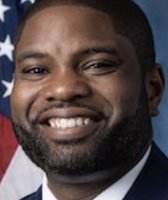

“There is no history … that shows an air campaign alone will result in positive regime change. In fact, there's not a single example of it in the entirety of American history.”

Our only agenda is to publish the truth so you can be an informed participant in democracy.
We need your help.

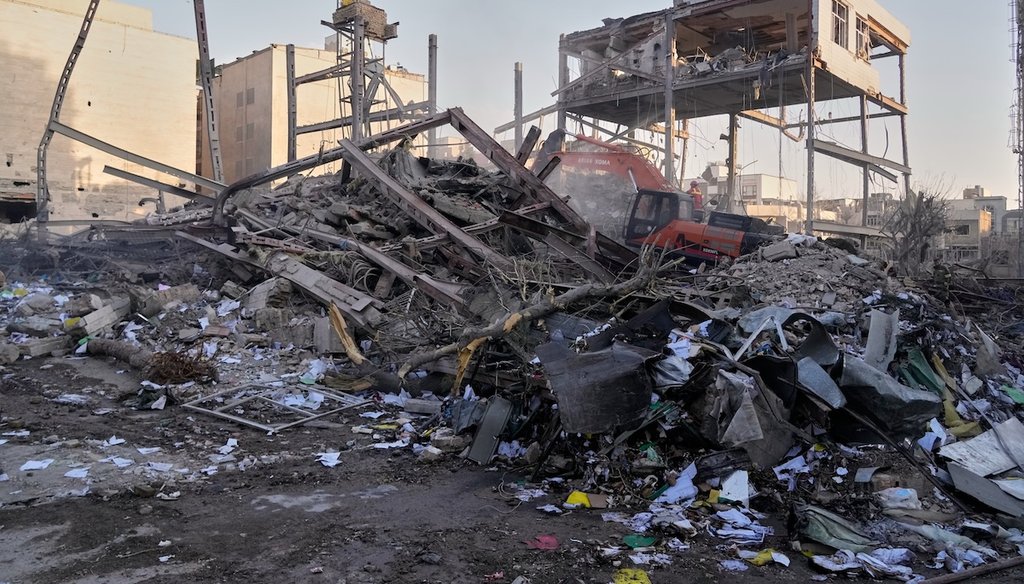
A police station was destroyed after being struck during a U.S.–Israeli military campaign in Tehran, Iran, on March 2, 2026. (AP)

Although some U.S. airstrikes have helped improve political conditions, experts said airstrikes alone are generally not enough to bring about regime change.
Usually, airstrikes combined with ground troops have a better likelihood of regime change success.
As President Donald Trump launched air attacks on Iran Feb. 28, skeptics quickly argued that ousting a foreign country’s government — as the U.S. may be pursuing in Iran — takes more than airstrikes.
Sen. Chris Murphy, D-Conn., said creating an improved political system is unlikely unless there are boots on the ground.
"There is no history … that shows an air campaign alone will result in positive regime change," Murphy said in a March 1 interview on CBS News’ "Face the Nation." "In fact, there's not a single example of it in the entirety of American history. An air campaign without at least the threat of a ground invasion, which the administration is ruling out, never results in a democratic rebirth in an authoritarian country."
Most of the seven military experts and historians we interviewed for this article agreed with Murphy.
"Airpower can have devastating effects, but without ground troops — or the clear threat of invasion — we have not seen regime change," said Barbara Slavin, a fellow at the Stimson Center, a foreign policy think tank.
A few experts cited a case or two that could undercut Murphy’s argument, but other experts pushed back against their interpretation.
On March 2, Trump declined to rule out ground troops. "Every president says, ‘There will be no boots on the ground.’ I don’t say it," Trump told the New York Post in an interview.
Defense Secretary Pete Hegseth also didn’t take ground troops off the table when asked about it at a press conference.
Murphy’s office did not respond to an inquiry for this article.
In World War II, the U.S. and its allies achieved regime change in Germany, Japan and Italy through a combination of air power and extensive use of ground troops over several years, resulting in more than 400,000 U.S. military deaths.
Many of the U.S. military interventions since then have involved U.S. ground troops, including the Korean War, the Vietnam War, the 1991 Persian Gulf War, the post-9/11 Afghanistan War and the Iraq War.
But other military campaigns in recent years have involved air warfare without significant numbers of U.S. ground troops. They include a 1986 airstrike that unsuccessfully targeted Libyan leader Moammar Gadhafi; two campaigns in the Balkans in the 1990s, in Bosnia and Kosovo; a continuing conflict in Yemen; allied airstrikes against Libya in 2011; Israel’s 12 day war against Iran in 2025; and the January 2026 U.S. mission to capture Venezuela’s leader, Nicolás Maduro.
"Airpower is extraordinarily effective at destroying infrastructure and eliminating individuals," Robert Pape, a University of Chicago political scientist, recently wrote. "It is far less reliable as a tool for reshaping political systems."
Pape wrote, "Removing a central figure is not insignificant. But in practice, regimes are networks: security services, political elites, patronage structures, ideological institutions. When an external power kills a leader, those networks often consolidate rather than fragment."
Pape wrote that although the 2011 airstrikes in Libya did oust Gadhafi, "The resulting chaos was deadly for Americans as the country spiraled out of control."
Murphy’s framing is a high bar, and it’s possible to achieve more modest goals with airstrikes, said David Silbey, a Cornell University military historian.
"The Libyan intervention of 2011 did not have democratic results, but it did achieve the American strategic goal of overthrowing Gaddafi and ending Libya’s support of terrorism," Silbey said. "So that seems a successful use of airpower, if not quite in the way" that Murphy framed the issue.
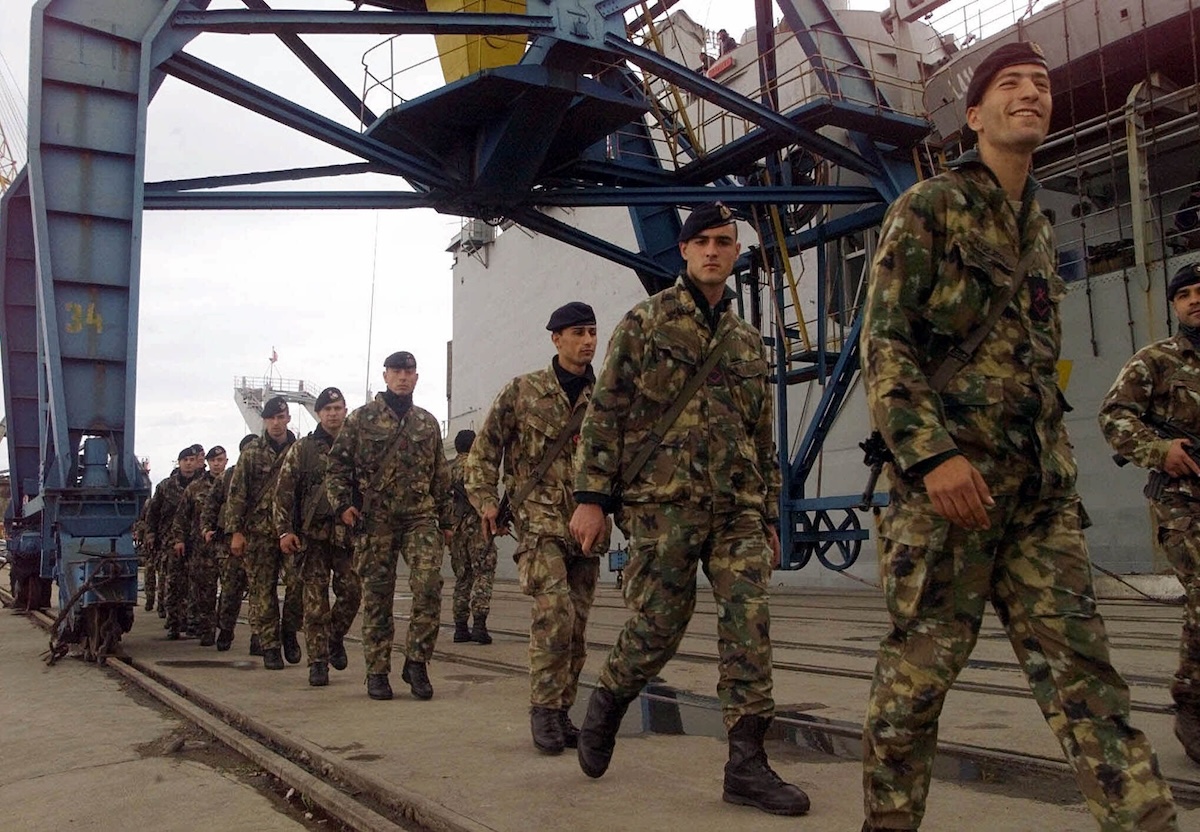
Italian soldiers under NATO command deployed to Albania on April 25, 1999, to help with the care of displaced Kosovar refugees. (AP)
Experts said the examples that come closest to achieving beneficial regime change through air warfare are Bosnia and Kosovo. But their support for his argument is far from foolproof.
Bosnia did have troops on the ground — United Nations troops to support humanitarian convoys with peacekeeping.
"In Bosnia, the August 1995 air campaign helped bring the Bosnian Serb Army and the Milosevic regime to Dayton, Ohio, for peace negotiations," said Gerard Toal, a Virginia Tech political science and international affairs professor. But it wasn’t just airstrikes in this case; local ground forces, the Croatian army and Army of Bosnia, were on the ground taking territory, he said.
After various twists and turns, the talks themselves became the catalyst for a more durable settlement, said Susan L. Woodward, a political scientist at the Graduate Center at the City University of New York.
As for Kosovo a few years later, an air campaign was eventually "combined with the threat of a ground campaign, though that threat was just beginning to take shape when the Serbs gave in," said Mark F. Cancian, a senior adviser at the Center for Strategic and International Studies, a national security think tank.
In addition, the Kosovo Liberation Army, a separatist militia, was active on the ground in Kosovo.
In any case, the Kosovo bombing did not achieve a full regime change, Woodward said. "The eventual decision on regime change was declared by Kosovar parties in 2008 — nine years later, and unilaterally, not a result of the bombing," she said.
Murphy said, "There is no history … that shows an air campaign alone will result in positive regime change. In fact, there's not a single example of it in the entirety of American history."
Although some U.S. airstrikes have helped improve political conditions, airstrikes alone are generally not sufficient to achieve regime change, especially regime change that produces a lasting political improvement. Usually, airstrikes combined with ground troops have a better likelihood of success.
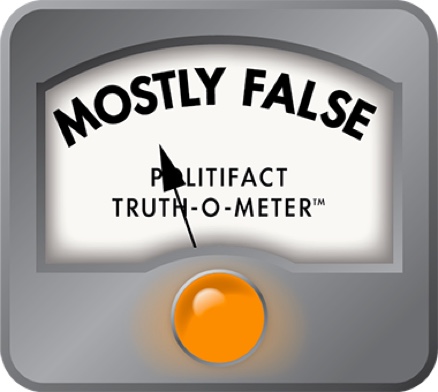
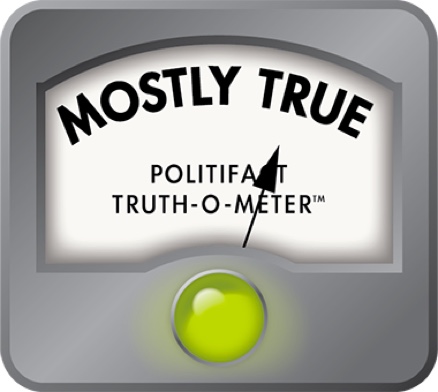
The statement is accurate but needs additional context, so we rate it Mostly True.
Senior Correspondent Amy Sherman contributed to this article.
Chris Murphy, interview with CBS News’ "Face the Nation," March 1, 2026
New York Post, "Trump won’t rule out sending US troops into Iran ‘if necessary’— tells The Post war is progressing ‘way ahead of schedule,’" March 2, 2026
Politico, "Hegseth doesn’t rule out US troops in Iran," March 2, 2026
Robert A. Pape, "Khamenei is dead. Regime change will be much harder," March 1, 2026
Associated Press, "Trump Talks Regime Change in Iran After Strikes, But History Shows That Could be Very Hard," March 1, 2026
Email interview with Boaz Atzili, professor of foreign policy and global security at American University, March 2, 2026
Email interview with Osamah Khalil, historian at Syracuse University’s Maxwell School of Citizenship and Public Affairs, March 2, 2026
Email interview with Michael O’Hanlon, director of research in foreign policy at the Brookings Institution, March 2, 2026
Email interview with David Silbey, Cornell University military historian, March 2, 2026
Email interview with Barbara Slavin, fellow at the Stimson Center, a foreign policy think tank, March 2, 2026
Email interview with Gerard Toal, professor of political science and international affairs at Virginia Tech, March 2, 2026
Email interview with Susan L. Woodward, political scientist at the Graduate Center at the City University of New York, March 2, 2026
Email interview with Mark F. Cancian, senior adviser at the Center for Strategic and International Studies, March 2, 2026
Other sources linked in article














In a world of wild talk and fake news, help us stand up for the facts.