Two reasons people think recent tech failures must be connected: our brains and online platforms


If your time is short
- So far, there’s no evidence that a series of technology outages and government system disruptions were coordinated or connected.
- Human brains notice patterns, are more affected by negative information and are more attuned to notice things that have just been in the news. Social media algorithms can amplify these anxieties.
It’s been one thing after another.
Companies including Microsoft, United Airlines, JPMorgan Chase and U.S. Bank experienced technical issues and outages that caused widespread banking issues, delayed plane departures and interrupted workdays across the world. Soon after, Marriott and Apple customers also experienced digital problems, and 178 companies reported being affected by a Nov. 16 cyberattack.
At the same time, various U.S. government systems — the Federal Aviation Administration, National Security Agency and National Weather Service — fell into disarray, including a rare nationwide ground stop. For many people, the pile-on of concerning news alerts had a sinister feel.
“We’re under attack in a way we’ve never seen before,” wrote Nalin Haley, a conservative influencer and son of Republican politician Nikki Haley, on Nov. 17. “This is an AI cyberattack.”
On Bluesky, Christopher Webb, a self-described “lifelong Dem” and party strategist, questioned whether the issues were connected.
“Coincidence??? 4 major banks reporting outages, a massive Microsoft disruption, and a nationwide FAA ground stop, all within days of each other,” he wrote Nov. 16.
The best available information points to mundane explanations such as routine maintenance, one-off problems or isolated cyberattacks, rather than an imminent systemic collapse or a coordinated attack on digital systems.
But why can that be hard to believe?
Human brains naturally detect patterns and reject uncertainty
The rapid-fire succession of events didn’t help. Neither did the timing of a planned, routine Nov. 17 test of the country’s Emergency Alert System.
Human brains are wired to make connections and spot statistical regularities in the world.
“Detecting patterns is important for perceiving the world and learning about cause and effect,” said Javier Granados Samayoa, a Texas Christian University psychology professor. This tendency “can sometimes lead people to see connections where none may exist.”
One paper about conspiracy thinking started with a coin toss. People who reported a tendency to notice patterns in a random string of coin tosses were more likely to also endorse conspiracy theories and supernatural beliefs.
Research also shows that when people lack control, they’re more likely to detect nonexistent patterns.
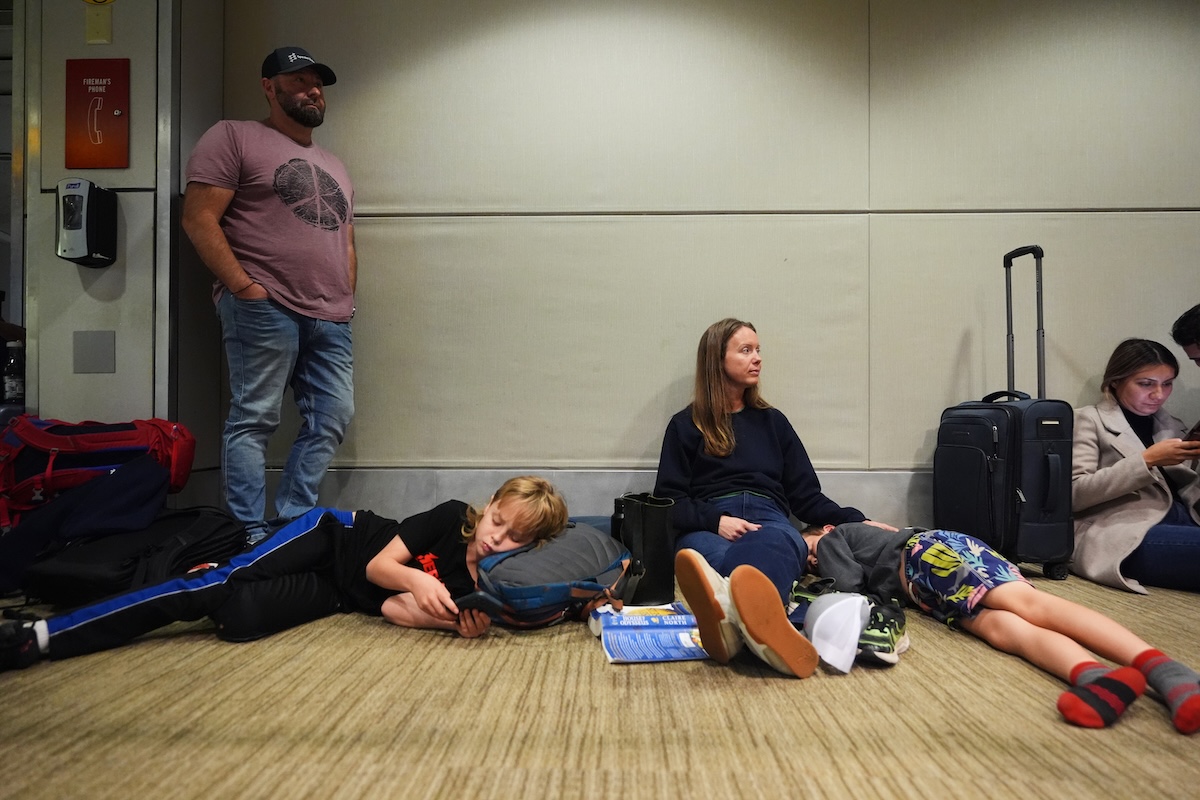
For people unable to access their work platforms or stuck at airports, powerlessness and confusion were all too familiar feelings. Those feelings contribute to embracing conspiracy theories.
“People are looking for ways to understand what is going on and they don’t like the uncertainty that often surrounds unfolding events,” said Karen Douglas, a University of Kent social psychology professor. “Also, a simple explanation is often not very appealing. People assume that there must somehow be a bigger explanation, or more going on than people know about.”
Human biases and social media platforms can intensify the anxieties
The flurry of frustration-inducing technical issues coupled with the known negativity bias observed across social media platforms can set people up to have outsized emotional reactions when things go wrong.
Negativity bias means that negative information has a stronger impact and people tend to think about it more, said Granados Samayoa. On social media, content is more likely to prompt engagement and go viral if it uses negative language or prompts a strong negative reaction.
Social media algorithms have continuously circulated some of the most alarming posts and conspiracy theories — an estimated 30% of which were pushed by suspected bots, including some with potential foreign influence, Axios reported.
Sharing conspiracy theories on social media is easy, fast and difficult to untangle.
“Once people believe in a conspiracy theory, it is often difficult to convince them otherwise,” Douglas said.
The events and concerns compounded as regular people and news reporters all began paying more attention to outages that would otherwise be routine. That’s commonly called frequency bias.
“United’s outage this afternoon is so pedestrian, it’d be a non-story if not for what’s happened the last four days,” Kyle Potter, an editor at Thrifty Traveler, wrote Nov. 16.
RELATED: As AI detects flaws in computer systems, is it causing more tech outages and disruptions?
Our Sources
Email interview with Javier Granados Samayoa, psychology professor at Texas Christian University, Nov. 19, 2026
Emailed statement from Karen Douglas, social psychology professor at the University of Kent, Nov. 19, 2026
ABC News, What to know about recent tech outages spurring cyberattack fears, Nov. 18, 2026
NPR, Telecom outage triggers rare nationwide FAA ground stop, stranding travelers : NPR, Nov. 14, 2026
NBC 6, Malware attack hits 178 popular websites: How to know if you were exposed, Nov. 18, 2026
CNBC, Widespread outages hit banks, air travel, the NSA and Apple, disrupting seemingly everything, Nov. 17, 2026
Yahoo!Travel, Affected by the FAA ground stop? Here’s what you need to know, Nov. 16, 2026
WGRZ, Experts say recent nationwide tech outages are not connected, Nov. 17, 2026
CBS News, Rubio says there’s “zero evidence” recent tech outages are related, Nov. 17, 2026
Bluesky post, Nov. 16, 2026
X post, Nov. 17, 2026
WINK, National Weather Service websites and data services restored after interruption, Nov. 17, 2026
CNN, Social media algorithms are encouraging Americans to freak out about the tech outages, Nov. 17, 2026
European Journal of Social Psychology via PubMed Central, Connecting the dots: Illusory pattern perception predicts belief in conspiracies and the supernatural, Sept. 25, 2017
European Journal of Social Psychology, Belief in conspiracy theories: Basic principles of an emerging research domain, Aug. 1, 2018
PLOS One, News source bias and sentiment on social media, Oct. 23, 2024
University of Cambridge, Why social media users like sharing negative news, accessed Nov. 19, 2026
Yashar Ali’s Bluesky post, Nov. 17, 2026
Kyle Potter’s X post, Nov. 16, 2026
Stanford Report, How ‘For You’ feeds amplify outrage, Aug. 18, 2026
WPSD, Facebook algorithm favors content that gets negative responses from users, Oct. 7, 2021