More than 500 people have gotten dengue in Florida this year. How does infection spread?


On Nov. 5, low flying helicopters blanketed areas of Florida’s Pinellas and Hillsborough counties, Florida, with a fine mist. It’s one of the ways Florida health officials hope to slow the country’s largest dengue fever outbreak in more than a decade.
Dengue starts with a mosquito bite, so killing the insects is key. The helicopters spray water mixed with Bti, a natural bacteria found in soil that kills black fly and mosquito larvae.
Most people become infected when traveling in high dengue risk areas, and Florida had recorded 382 international travel-associated cases as of Oct. 31. But the state has also counted a recent record high number of people infected on Florida’s turf: 524.
Florida has had domestic dengue outbreaks before. In 2010, it counted 58 locally acquired cases, after nearly eight decades of reprieve. Since then, the largest outbreak was in 2023, when the state reported 189 dengue cases contracted in Florida.
As Florida navigates its largest dengue outbreak in more than 15 years, it might help to understand how this virus spreads and how to recognize symptoms and protect yourself. We sought answers to some pressing dengue fever questions.
What is dengue fever?
Dengue fever can develop after a person is infected with any of the four dengue viruses. The virus is not transmitted person-to-person, and there is no widely available vaccine to prevent infection.
About 3 in 4 people do not get sick, but if symptoms develop, they typically set in about four to 10 days after an infected mosquito’s bite.
The most common symptoms of mild dengue fever include high fever, headache, nausea, vomiting, rash, pain behind the eyes and muscle, joint and bone pain.
About 1 in 20 people infected with a dengue virus develops a more severe form of dengue fever sometimes called dengue hemorrhagic fever or dengue shock syndrome. Severe dengue is a life-threatening medical emergency that can cause shock, internal bleeding and death.
Warning signs of a severe infection include serious stomach pain or tenderness, vomiting at least three times in 24 hours, bleeding from the gums or nose, rapid breathing, blood in stool or vomit, restlessness, feeling extremely tired and bleeding under the skin that might appear as purplish spots or patches.
Those symptoms typically happen 24 to 48 hours after the fever, and they often come on quickly. Anyone experiencing them should seek immediate medical care.
What is the treatment for dengue fever?
There is no specific cure or treatment. Most people recover in about one week, the Centers for Disease Control and Prevention said. The CDC recommends people rest, hydrate, and take acetaminophen to reduce fever and pain. Avoid other pain relievers such as aspirin and ibuprofen because they can raise the risk of bleeding.
For severe dengue fever, medical professionals might monitor a patient’s blood pressure and platelet count and provide blood transfusions or intravenous fluid and electrolyte replacement.
Can someone develop immunity to dengue?
After being infected with a dengue virus, a person’s immune system learns to fight that type of virus, which helps protect them from reinfection with that same virus. But he or she could remain susceptible to the other three dengue viruses.
A person might be asymptomatic or have mild symptoms during an initial dengue infection, and then develop more severe symptoms — or, in rare cases, dengue hemorrhagic fever — after being infected with a second type of dengue virus, said Kristi Miley, a University of Florida public health professor.
“Dengue is a doozy, mainly because the second infection can be more dangerous than the first,” Katelyn Jetelina, an epidemiologist and public health expert, said in social media posts.
Florida has documented all four dengue viruses since 2009. The type of dengue virus that’s predominantly circulating now “has been noted to cause more severe symptoms than the other three serotypes,” Miley said.

Why are there so many cases in Florida this year?
Florida’s climate and environment provides ideal conditions for the Aedes species mosquitoes that spread dengue to thrive.
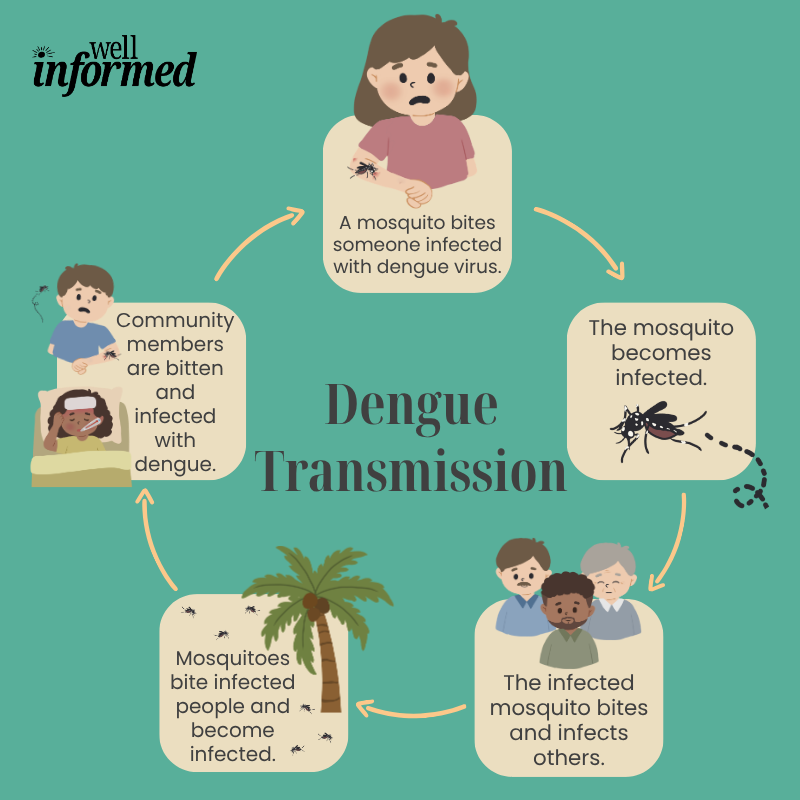
If someone travels to a dengue endemic country and becomes infected even asymptomatically, dengue can enter a community. When a mosquito bites a person infected with the dengue virus, it can introduce the virus to the local mosquito population. An infected female mosquito will remain infected for her life — and she can pass the virus to her eggs, which can result in more than 500 infected offspring, said Miley.
“When you consider the multiplication equation here and add that to the amount of excessive rainfall that the state has been experiencing this late in the year, one can quickly see how an outbreak of this magnitude can happen,” she said.
All told, the previous 16 years saw only 606 total locally acquired cases.
“Studies are ongoing to better understand the factors contributing to the dengue activity being seen in Florida in 2026,” said Isabella White, a Florida Department of Health spokesperson.
Does the risk extend beyond Florida?
Yes. Not every state has the climate to support Aedes mosquito populations, but any state that does could potentially see local transmission of dengue.
In 2025, CDC data showed locally acquired dengue in Florida, California and Arizona.
In August, Virginia health officials reported a locally acquired dengue fever infection.
How can people protect themselves and others against dengue?
The mosquitoes that carry dengue breed in standing water, so health officials urge people to be vigilant about eliminating it around their homes.
“Dump or cover any standing water — especially after each time it rains,” Miley said.
Florida’s Department of Health recommends discarding old tires and drums, emptying and cleaning bird baths or pet water bowls at least once or twice a week and protecting vehicles and boats with tarps so water cannot accumulate.
Prevent mosquito bites by using Environmental Protection Agency-registered insect repellants such as deet and picaridin and covering skin with shoes, socks, and long sleeves and pants.
The mosquitoes known to carry dengue are often considered “day biters,” Miley said.
If you suspect you’ve been infected with the dengue virus, seek medical attention and avoid exposure to mosquitoes for seven days following symptoms — that’s how long a person would be able to infect mosquitoes, enabling them to spread the disease, Miley said.
RELATED: Sometimes fighting dangerous pests like screwworms and mosquitoes means sterilizing bugs
Our Sources
Email interview with Kristi Miley, a research associate and professor at the University of Florida, Nov. 4, 2026
Email statement from Isabella White, a Florida Department of Health spokesperson, Nov. 5, 2026
PBS News, Florida’s dengue outbreak is largest in continental U.S. in decades, Oct. 5, 2026
Tamba Bay Times, Inside the fight against mosquitoes spreading dengue fever in Florida, Sept. 4, 2026
Bay News 9, Helicopters spray Tampa neighborhoods as dengue cases climb, Nov. 4, 2026
CIDRAP, Tampa woman dies from dengue as Florida fights surge of cases, Oct. 6, 2026
Herald-Tribune, Florida dengue cases surge to 485 in largest outbreak in US in decades, Oct. 30, 2026
WUSF, Rare dengue death confirmed in Tampa as state’s mosquito control experts stress vigilance, Sept. 19, 2026
WUSF, How Florida became the epicenter of localized U.S. dengue cases and what role climate played, Nov. 5, 2026
Tamba Bay Times, A Tampa woman was diagnosed with dengue fever. Within a week, she was dead, Sept. 8, 2026
Los Alamos Medical Center, Why Mosquito-Borne Illnesses Are on the Rise — and How to Protect Yourself, Aug. 1, 2025
Harvard Gazette, Threat of mosquito-borne diseases rises with global temperature, Oct. 15, 2024
The Lancet Regional Health, Dengue transmission risk in California under climate and land-use change: a semi-mechanistic modelling study, August 2026
Pinellas County, Mosquito-transmitted Dengue – Pinellas County, accessed Nov. 5, 2026
Florida Department of Health, Dengue Fever, accessed Nov. 5, 2026
Florida Department of Health, Florida Arbovirus Surveillance – Week 42, accessed Nov. 5, 2026
Florida Department of Health, Florida Arbovirus Surveillance – Week 43, accessed Nov. 5, 2026
Current Tropical Medicine Reports via Springer Nature Link, The History of Dengue in the United States and its Recent Emergence, Jan. 22, 2014
Centers for Disease Control and Prevention, Historic Data (2010-2025) | Dengue, accessed Nov. 5, 2026
Mayo Clinic, Dengue fever – Symptoms and causes, accessed Nov. 5, 2026
Mayo Clinic, Dengue fever – Diagnosis and treatment, accessed Nov. 5, 2026
Centers for Disease Control and Prevention, About Dengue, accessed Nov. 5, 2026
Yale Medicine, Dengue Fever | Fact Sheets, accessed Nov. 5, 2026
The Associated Press, Millions infected with dengue this year in new record as hotter temperatures cause virus to flare, Dec. 13, 2023
Your Local Epidemiologist’s social media posts, Oct. 14, 2026
The Houston Chronicle, Dengue fever returns to Florida Disease had been dormant for nearly 80 years, Aug. 22, 2010
American Society for Microbiology via PubMed Central, Transmission Potential of Floridian Aedes aegypti Mosquitoes for Dengue Virus Serotype 4: Implications for Estimating Local Dengue Risk, July 7, 2021
Microbiology Resource Announcements, Complete Genome Sequence of Dengue virus Type 2 from a Resident of North-Central Florida with Locally Transmitted Dengue Fever, Aug. 3, 2017
Florida Department of Health, Florida Arbovirus Surveillance Week 52, December 24-30, 2023
University of Colorado Anschutz, Dengue-Carrying Mosquitoes Expand Their Reach Into New Territories – Including Florida, Sept. 25, 2026
Virginia Department of Health, VDH Identifies a Locally Acquired Case of Dengue Virus Infection in Northern Virginia Resident – Clinicians, Aug. 4, 2026
Pinellas County, Mosquito Control conducts aerial larvae treatments in Clearwater and St. Pete on Thursday, Nov. 5, 2026
Insects via PubMed Central, Dengue in Florida (USA), Dec. 16, 2014
WUSF, Hillsborough reports lowest dengue increase in weeks, extends state of emergency, Nov. 6, 2026
Hillsborough County, Aerial Mosquito Treatments Planned Day and Night Across Hillsborough County, Nov. 3, 2026