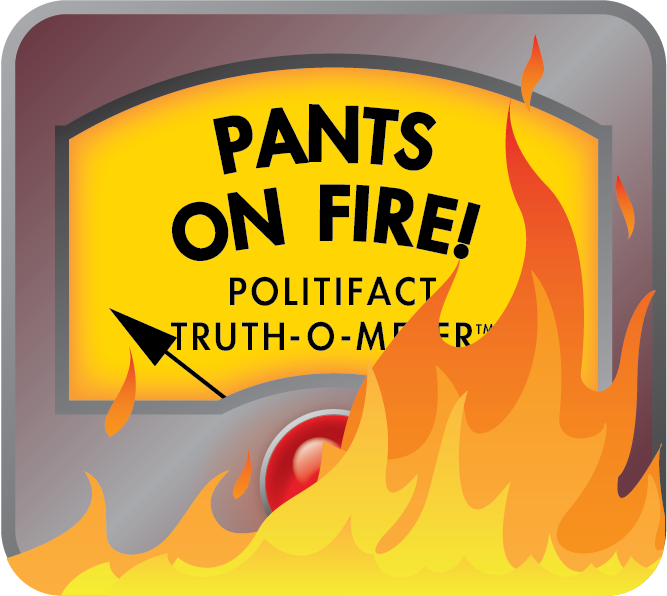
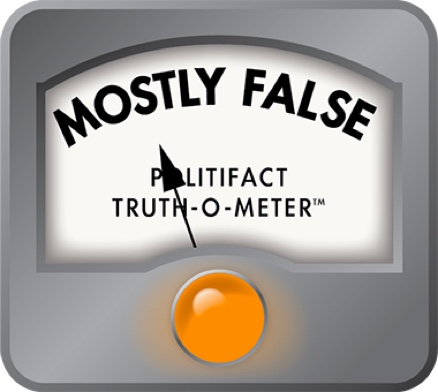


Zach Nunn said Republicans passed the largest tax cut in U.S. history. This is Mostly False.
If your time is short
- Economists say that measuring tax cuts as a percentage of gross domestic product, or GDP, is the best method. The One Big Beautiful Bill is tied for the sixth-largest tax cut when looking only at the new tax cuts added by the bill.
- It is the third-largest tax cut when its new cuts are combined with the 2017 tax cuts that were extended by the bill.
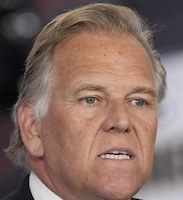
U.S. Rep. Zach Nunn, R-Iowa, praised Republicans’ tax cuts as the largest in history as he campaigns for reelection to Iowa’s 3rd Congressional District.
In a Sept. 8 social media video, Nunn said, “We have cut the largest taxes in U.S. history,” when addressing volunteers door-knocking.
Nunn is referring to President Donald Trump’s signature legislation, the One Big Beautiful Bill Act, which became law in summer 2025. The bill extended tax cuts from the 2017 Tax Cuts and Jobs Act that were set to expire and added several new tax cuts.
Other Republicans, including Vice President JD Vance, have also called the legislation the largest tax cut in history, and PolitiFact rated that Mostly False.
The 2017 Tax Cuts and Jobs Act lowered the average income tax rates for all income groups, with the largest cuts concentrated among the top 5% of earners. The act was set to expire on Dec. 31, 2025.
With the passage of the One Big Beautiful Bill Act, those tax cuts were extended. The legislation also enacted tax breaks for people who work overtime or receive tips. The marginal rates were also adjusted for tax year 2026.
Measured against the size of the economy, the tax savings in the 2025 law were smaller than earlier laws. Where the law ranks depends on whether you count extending the tax cuts that were set to expire, or only the law’s new tax cuts.
When PolitiFact Iowa asked Nunn’s campaign for more information to support his statement, a spokesperson pointed to an article by Heritage Action, an arm of the Heritage Foundation, a conservative think tank. It says Americans would face the largest tax increase in “generations” if the 2017 Tax Cuts and Jobs Act were to expire.
Independent economists disagree that it’s the largest tax cut.
“The 1981 Reagan tax cut was substantially larger relative to the economy,” said Anne Villamil, University of Iowa professor of economics.
The 1981 Economic Recovery Tax Act cut marginal taxes by more than 25% over three years. The act was aimed at encouraging economic growth by reducing corporate income tax for businesses making less than $50,000 annually and introducing more benefits for married couples.
How do economists measure tax cuts?
When calculating tax cuts, economists consider multiple factors.
OBBBA is projected to gross $4.5 trillion over 10 years, according to the Congressional Budget Office. Tax bills’ total value increases over time because of inflation. So the ideal way to understand tax cuts is as a percentage of gross domestic product, or GDP. This put the cuts into the context of inflation and the overall economy.
Counting just the new tax cuts in the OBBA, they make up 0.5% of GDP . When looking only at the new tax cuts added by the bill, it ranks tied for sixth-largest cut overall since 1980, PolitiFact previously reported.
When factoring tax cuts extended from the 2017 Tax Cuts and Jobs Act, the OBBBA ranks third largest since 1980. Economists have previously told PolitiFact it’s legitimate to measure the size of the tax cuts either way. The law resulted in taxes being lower than they’d be if the 2017 tax cuts expired, but many taxpayers could see little change in taxes because rates stayed the same as in recent years.
Carrie Houchins-Witt, an enrolled agent professional at Carrie Houchins-Witt Tax and Financial Services, said “a large swath of taxpayers are not seeing any tax cut,” and some people saw their taxes increase. The senior deduction — $6,000 for people 65 and older making less than $75,000 a year — did benefit many of her clients, she said.
Our ruling
Nunn said, “We have cut the largest taxes in U.S. history.”
While the tax cuts are projected to be nominally large, the more effective way of understanding them is in the larger context of the economy.
When looking exclusively at new tax cuts, the OBBBA is tied for sixth-largest since 1980. But, when viewing the OBBBA as an extension of the 2017 Tax Cuts and Jobs Act, the bill sits at third largest.
This statement contains an element of truth but ignores critical facts that would give a different impression. We rate the statement Mostly False.
CORRECTION, Oct. 8, 2026: The One Big Beautiful Bill Act’s senior deduction applies to people 65 and older. An earlier version of this fact-check listed an inaccurate eligibility age.
Our Sources
Tax Foundation, Is the OBBBA the “Largest Tax Cut in American History?”, Nov. 14, 2025
White House, The Largest Tax Cut in History for Working and Middle-Class Americans, June 10, 2025
Ways and Means, PASSED: The One, Big, Beautiful Bill – The Largest Tax Cut in American History, July 3, 2025
Bipartisan Policy Center, U.S. Tax Reform Timeline, 1945-Present, Dec. 2, 2025
Instagram, Team Nunn is out in force across all 21 counties, ready to bring home a big WIN for Iowa in November. Sept. 8, 2026
Congressional Budget Office, Effects on Deficits and the Debt of Public Law 119-21, Aug. 4, 2025
Congress, H.R.4242 – 97th Congress (1981-1982): Economic Recovery Tax Act of 1981
Email interview with Douglas Blair, Heritage Action Press Manager, on Oct. 2, 2026
Phone interview with Carrie Houchins-Witt, Enrolled Agent Professional at Carrie Houchins-Witt Tax and Financial Services, Oct. 5, 2026
Email and phone correspondence with Zach Nunn campaign, Oct. 5, 2026
Text message correspondence with Anne Villamil, professor of economics at the University of Iowa, Oct. 5, 2026