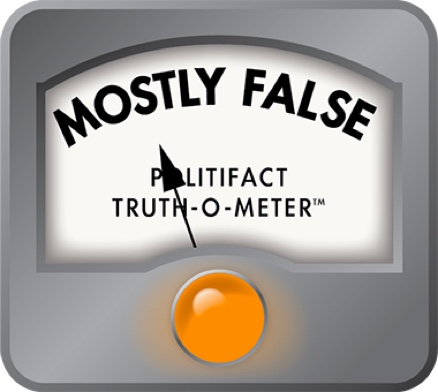
Fact-checking Mullin’s claim that foreign adversaries can access voting machines

If your time is short
- Intelligence assessments and computer science experts have long flagged potential vulnerabilities in voting machines.
- Foreign enemies can potentially access voting machines’ hardware. But integrated security measures would make it difficult to pull off large-scale attacks.
- There has been no evidence that foreign adversaries have attempted to conduct such attacks in previous elections.
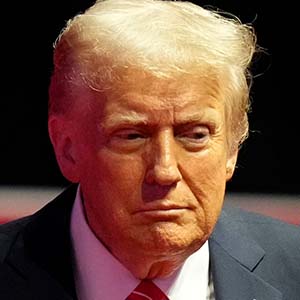
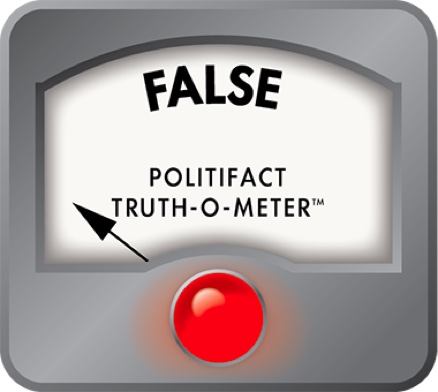
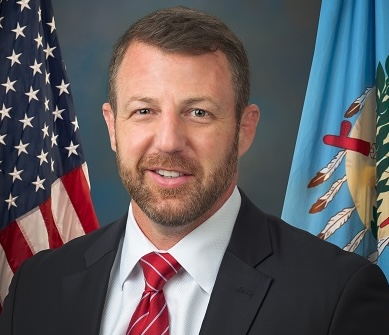
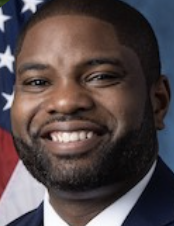
Department of Homeland Security Secretary Markwayne Mullin recently said, in unequivocal terms, that foreign adversaries can access voting machines and flip votes, echoing President Donald Trump’s narrative about interference in the 2020 election.
“We know for sure that our foreign adversaries, not our allies, foreign adversaries have parts that are vital pieces in our voting machines,” Mullin said July 17, adding that they can access “what they consider the key to the back” of the voting machines. “We know that they can change voter registration and your vote. We know it’s possible. There’s not a question. It’s not even for debate.”
We asked the Department of Homeland Security for more details but it did not give any; it reiterated its call for states to help guard against noncitizen voters. The White House referred us to that department. (Noncitizen voting in federal elections is rare.)
The process of registering to vote does not involve voting machines.
But Mullin’s comments about voting machines reflect concerns that security and election technology experts have long had. Voting machines have weaknesses that can allow foreign adversaries to tamper with voting machine hardware and weaken the machines’ security, said J. Alex Halderman, University of Michigan computer science and engineering professor who studies electronic voting machines. Hardware attacks would allow foreign actors to manipulate the machines’ security controls.
But so far, there’s no proof of such attempts.
“It’s important to note that there’s no evidence that voting machine vulnerabilities have ever been used to attack a real U.S. election, and of course the existence of vulnerabilities does not mean those vulnerabilities will imminently be exploited,” Halderman told PolitiFact via email.
The U.S. Senate Select Committee on Intelligence noted these risks in a 2019 report on Russian interference in the 2016 election. The report said that in an experiment at a security conference, participants were able to hack into voting machines to change votes, install software and perform other unauthorized functions.
But this was possible in part because the hackers were given physical access to the machines. Under real circumstances, election officials implement various measures to secure voting equipment. Machine access is restricted, and they are stored in locked areas with video surveillance. Election officials keep track of where machines are moved and who accessed them.
Voting machines are typically not connected to the internet or to each other, said a 2024 National Intelligence Council assessment of foreign threats after the Nov. 5, 2024, election.
Halderman was part of an academic group in 2006 that analyzed the security of certain voting machines that let voters cast and store their votes electronically, sometimes without a paper record of their vote.
“What we found was disturbing,” Halderman told the Senate intelligence committee in 2017. “We could reprogram the machine to invisibly cause any candidate to win.”
In 2021, as part of a Georgia court case, Halderman also simulated a vote-stealing tactic in which an attacker hides hardware in a ballot printer to swap which candidate was marked on the ballot.
The judge gave him complete access to machines, and experts argued that Halderman’s findings were not realistic. “If you leave the keys in an unlocked car and you’re surprised I can drive away in it, that’s not a measure of the car’s security,” Tammy Patrick, a former Maricopa County, Arizona, elections administrator, told Votebeat in 2022.
In a 2021 report, federal intelligence agencies said they did not find proof of foreign actors attempting to manipulate election processes in the 2020 U.S. election. Attempts to do so at scale would likely be detected through physical and cybersecurity monitoring or in audits, the report read.
Andrew Appel, Princeton University professor emeritus of computer science who studies the technology policy of voting machines, said most voting machines today are more secure than the ones designed in 2000.
The vulnerabilities that still exist are why most states still use paper ballots that are marked by hand and recountable by hand, Appel said. Paper ballots provide a way to verify and audit votes.
RELATED: Vivek Ramaswamy has called for ‘paper ballots.’ Most Americans vote that way already.
Our Sources
Emailed statement from the Department of Homeland Security, July 17, 2026
Emailed statement from The White House, July 22, 2026
PolitiFact, Tulsi Gabbard exaggerates saying kid hacked replica voting machine, July 3, 2019
PolitiFact, Trump lawyer falsely claims voting technology company changed votes in 2020 election, November 19, 2020
Associated Press YouTube video, LIVE: Markwayne Mullin holds a press conference on election security, July 17, 2026
PolitiFact, Fact-checking the Trump administration’s count of 250,000 noncitizens on the voter rolls, July 17, 2026
Email interview with J. Alex Halderman, computer science and engineering professor, University of Michigan, July 17, 2026
U.S. Senate Select Committee on Intelligence, Report of the Select Committee on Intelligence, United States Senate, on Russian Active Measures Campaigns and Interference In The 2016 U.S. Election, Volume 1: Russian Efforts Against Election Infrastructure with Additional Views, 2019
U.S. Election Assistance Commission, Voting System Security Measures, accessed July 22, 2026
National Intelligence Council, Foreign Threats to US Elections After Voting Ends in 2024, Oct. 8, 2024
Brennan Center for Justice, Brennan Center overview of voting equipment, May 13, 2018
Curling v. Raffensperger, Security Analysis of Georgia’s ImageCast X Ballot Marking Devices by J. Alex Halderman, July 1, 2021
Votebeat, Why the debate over a computer scientist’s Dominion report is so heated, March 2, 2022
Interview with Andrew Appel, professor emeritus of computer science, Princeton University, July 17, 2026
National Intelligence Council, Foreign Threats to the 2020 US Federal Elections, March 10, 2021
The White House, Election Integrity, accessed July 22, 2026
Email interview, Ronald Rivest, MIT Institute Professor of electrical engineering and computer science, July 19, 2026