Fact-checking Ed Markey and Seth Moulton’s final debate in Massachusetts Democratic primary
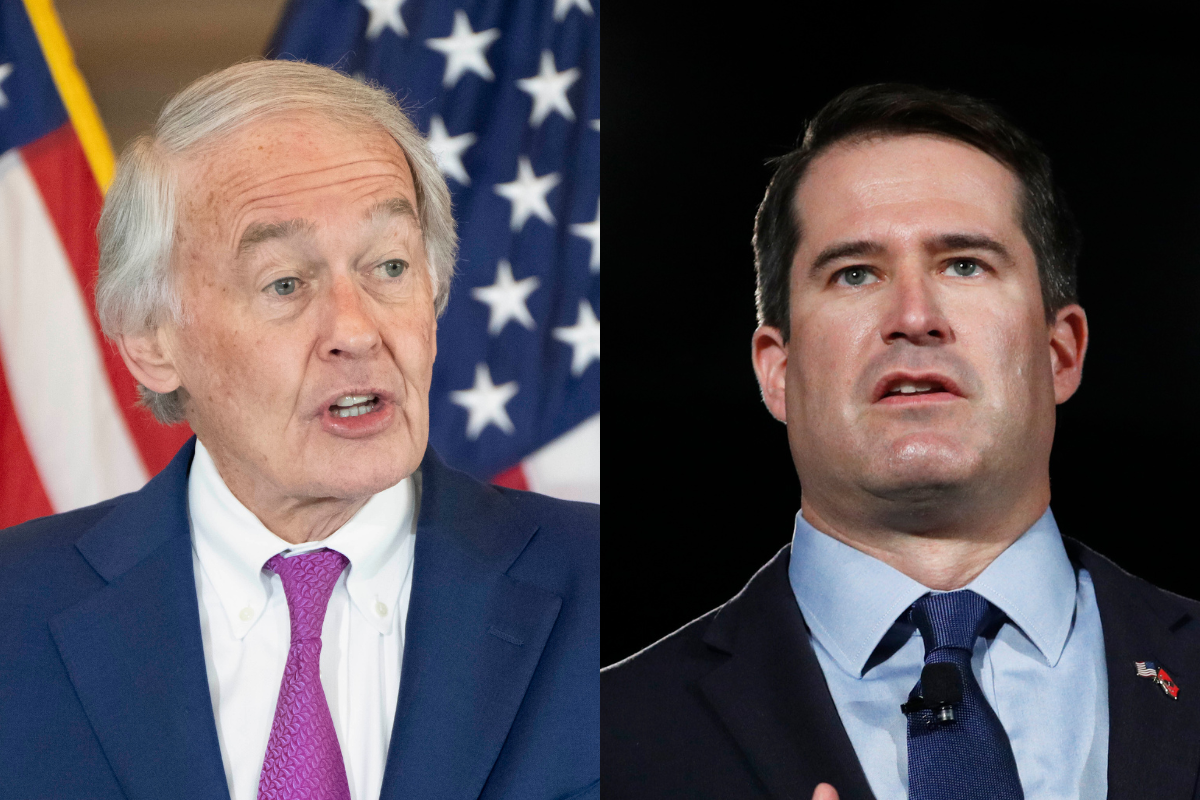






Sen. Ed Markey and U.S. Rep. Seth Moulton faced off for the third and final time in the Massachusetts Democratic primary for U.S. Senate. Despite broad similarities in ideology, the candidates used the debate to sharpen differences in their ages, the actions they’ve taken in office and their use of technology.
“We should have age limits for Congress,” said Moulton, 47. Markey, who is 80, said Moulton “has a hard time keeping up with me in the course of this campaign.”
When asked by panelist and Boston Globe columnist Adrian Walker about how he personally uses artificial intelligence, Markey said he uses “whatever comes up” in his phone and computer. Moulton said he’s “very careful about how to use it” and urged Congress to pass protections.
Moulton said, “Senator, if you don’t even know what you’re using on your phone or your iPad, like this is why we need a new generation of leaders to regulate these technologies to make sure that they are safe.”
PolitiFact fact-checked the debate with our partner WCVB-TV, which cohosted the debate with WBUR-FM and The Boston Globe.
Here’s our look at some of the debate’s key moments.
Moulton: “You would hear from Massachusetts residents that their electricity bills are too high. They’re literally twice as high as the national average.”
Moulton is close.
Massachusetts’ average residential electricity rate was 28.82 cents per kilowatt-hour in May, about 1.5 times the national average of 18.44 cents per kilowatt-hour, according to the latest available data from the U.S. Energy Information Administration.
When asked for more information about Moulton’s statement, his campaign sent PolitiFact a March report by the U.S. Chamber of Commerce that lists Massachusetts at 25.56 cents per kilowatt-hour, compared with the national average of 13.63, which is around 1.9 times higher.
The newer May data is slightly different. That’s because electricity rates are based on several fluctuating factors, including seasonal shifts in energy demand and changing wholesale fuel costs.
Massachusetts’ rates are high, but within the continental U.S., California’s — at 33.25 cents per kilowatt-hour — are the highest. Choose Energy, a website that collects local energy data and lets users shop for rates, places the Massachusetts residential electricity rate behind Hawaii, California, New York and Rhode Island, based on May data.
Moulton: Markey’s “proudest piece of legislation is the 1996 Telecom Deregulations Act that opened the door to big tech having no accountability, to kids literally dying on the internet through social media.”
Markey replied that he authored the Child Online Privacy Protection Act and “that’s how families can sue Google, sue YouTube if their kids have been harmed,” and that his legislation passed the Senate Commerce Committee “so that kids don’t get addicted to these chatbots.”
Markey co-authored the 1996 Telecommunications Act, which has a provision shielding social media platforms from liability for the content users post on their feeds.
Part of the law says platforms cannot be treated as “the publisher or speaker” of information others post.
That provision, which stemmed from the Communications Act of 1934, is often cited as the “twenty-six words that created the internet.”
One University of Cincinnati Law Review article said some recommended content on social media platforms has resulted in users’ hospitalization and death, and that social media has facilitated crimes against children.
Markey authored the 1998 Children’s Online Privacy Protection Act when he was a U.S. representative. But he overstated what it does.
The law created data protection policies for children under 13, and is responsible for the common 13-year-old age minimum for creating accounts online.
But the law doesn’t let parents sue tech companies on the basis of harm to kids. Only federal regulators and state attorneys general can bring lawsuits for violations. An appeals court ruled in 2023 that the law doesn’t preempt state laws regulating the same conduct, but parents were suing under a state law in that case, not the federal law.
Markey introduced the Youth AI Privacy Act in March, and it passed a Senate committee Aug. 5. The bill would require chatbots interacting with minors to display notices they aren’t human and limit addictive features and data collection.
Markey, when asked if transgender athletes should be allowed to participate in girls’ sports: “Yes, I do. That is the law in Massachusetts, and I think it’s the correct law.”
Markey’s comment about the law is accurate.
The Massachusetts Interscholastic Athletic Association said a state law that protects students from discrimination based on sex was expanded to protect students based on gender identity.
Because of the law and based on guidance from the state Department of Elementary and Secondary Education, the association said students can play sports “in accordance with their identified gender, not necessarily their birth assigned gender.” The association has more than 380 member schools that serve more than 220,000 student athletes.
The association also said that when a school district submits a roster, “No students are included on the roster solely for the purpose of gaining an unfair advantage in competitive athletics.”
Markey also said that the U.S. Supreme Court ruled that in states with no protections for transgender athletes, “Those kids lose their protections.”
The U.S. Supreme Court ruled in June that state laws banning transgender athletes from women’s and girls’ sports at schools and colleges are constitutional and compatible with Title IX protections. The ruling did not prohibit states like Massachusetts from allowing transgender athletes on girls’ sports teams.
Markey: After the U.S. bombed Iranian nuclear facilities in June 2025, Moulton voted against an impeachment resolution that was “brought onto the floor of the United States Senate,” and in December 2025, Moulton “voted for the trillion-dollar defense budget.”
Moulton: “Senator Markey, I’m not in the Senate, so I didn’t vote on an impeachment resolution in the Senate, and I voted against the defense bill after the war in Iran started.” Markey “voted to start the Iraq War.”
The candidates tried to draw dividing lines on the Iran war started by President Donald Trump, which both oppose. Here are the facts:
Impeachment votes: The House has held two impeachment votes since Trump started his second term, both before the current war began on Feb. 28. Moulton voted in opposite ways.
In the June 2025 vote, Moulton voted with a majority of Democrats in favor of tabling (that is, to dismiss) the impeachment motion by Rep. Al Green, D-Texas. In December 2025, Moulton voted against tabling a new impeachment measure from Green, meaning he wanted the House to continue considering it. Moulton once again sided with a majority of House Democrats.
Voting for a trillion-dollar defense budget: Markey’s statement is cherry-picked. Congress passes two kinds of legislation relating to the Pentagon. One is an appropriations bill, which provides funding. The other is an authorization bill, which addresses policies and administrative matters; it does not directly fund government activities.
Moulton voted for a December 2025 authorization bill. His statement about the bill said it included important oversight and policy guardrails.
When an appropriations measure that included defense spending came up in January and February, Moulton voted against it both times. He also voted against an earlier appropriations bill in July 2025, and he voted against a subsequent authorization bill in June.
Iraq war vote: Moulton is correct that Markey voted to authorize then-President George W. Bush to launch war against Iraq in 2003. Earlier this year, Markey called his vote a “mistake.”
RELATED: Moulton cherrypicks Epstein files to turn tenuous connection to Ed Markey into campaign attack
RELATED: Pro-Ed Markey ad says Seth Moulton ‘thanked ICE.’ Moulton has called to abolish the agency.
Our Sources
See links within story.